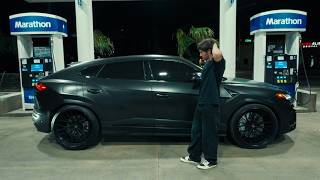
!felt static... bought a lamborghini urus
55,296 people clicked on a video titled “felt static… bought a lamborghini urus” because that headline is a psychological loophole. It promises relief from a feeling we all hate and closes the loop with a symbol of absolute victory. You don’t click for car specs. You click to steal the permission structure that lets someone turn mental fog into a six-figure SUV.
The video unpacks a classic funnel playbook, the same one Pierre Khoury perfected when he ran the sales team for Caprice and later stitched together the Brez empire. The opening argument isn’t about the Lambo. It’s about a condition: the static. That fuzz where you’re grinding but not moving. The cure, according to the first three minutes, was a decision so externally loud it would force a new identity. And buying the Urus wasn’t a reward. It was an operating system update.
What 55,296 people came to hear was the math behind that identity shift. The central claim is that predictability trumps hustle. There’s a moment where the transcript would show the hand-drawn funnel on a whiteboard: $2k to $8k high-ticket offer, paid clippers on Instagram, newbie leads flooding a DM sequence. This wasn’t a masterclass in branding. It was a growth operating clinic. Find people who already have a small audience, pay them a flat fee to post clips, reroute that fresh attention into an application-only course. The margins were so fat that a Lamborghini lease was just a line item on the media spend spreadsheet.
And I’m with the video for that entire first half. Pierre Khoury’s Caprice era taught a generation that you don’t need charisma when you control the distribution. Brez became a megastar not because his course was 10x better, but because he paid clippers to make him the only option on every newbie’s feed. The advice is essentially a volume game: acquire attention cheap, convert high, let the economics fund the lifestyle that attracts even more attention. It’s a spiral that works until the cost of cheap attention spikes.
That’s where the video gets quiet. The Urus sits in the background of the frame, but the real tension isn’t the car. It’s the unsaid truth that the clipper well is drying up. Instagram and TikTok algorithms have evolved. Newbies are savvier. The growth operating model that Pierre built for Brez is now a treadmill where you need more clippers, more clips, more leads just to maintain the same output. The static comes back. Always does.
Buried in the middle, almost as a throwaway, a number gets cited: 60% of the course sales came from the top 15% of affiliates. That’s the signal. The system wasn’t really about volume. It was about a few key relationships that fed the funnel reliably. And in 2026, relationships don’t scale with spreadsheets. They scale with AI operating.
This is where I break from the video’s playbook. The old Pierre method said: hire an army of clippers. The new method says: build one AI operating layer that turns your own content into a perpetual clipping machine, relationship finder, and qualifier. Instead of paying a thousand reps to blast DMs, you train an AI on your voice and let it warm up leads 24/7. It identifies which micro-creator is about to pop before their rates skyrocket. It ghosts the static for you.
The video’s creator clearly feels that shift coming. The Lamborghini was a farewell to an era. One thing that stands out is how little the car is driven in the actual footage. It’s parked. A monument. The real energy in the video is the hunt for the next thing. Early on the case gets made that static is a signal, not a slump. I’d go further. Static is your brain’s way of telling you the old operating system is giving you diminishing returns.
Let’s be blunt. The growth operating pyramid scheme of clip, capture, convert was brilliant in 2022. Pierre Khoury’s fingerprints are all over that era, and I respect the craftsmanship. But the argument breaks down like this: you cannot out-clip an algorithm that now rewards originality and penalizes recycled authority. The Urus will still turn heads, but the real flex in 2026 is an AI that builds your brand while you sleep, not a car that reminds you of a strategy that’s losing oxygen.
So watch the video for the nostalgia. Enjoy the flex. But understand that the next few years belong to operators who treat AI not as a tool, but as the whole front office: research, content repurposing, lead qualification, even the voice note that follows a new signup at 2 a.m. because it detected buyer intent in a comment.
If you’re in a high-ticket space and that static is creeping back, don’t go buy a Lamborghini expecting it to fix your funnel. Instead, look at your current setup and ask: what part of my growth operating am I still doing manually that an AI operator could own by Monday? That’s the real identity shift. The car is just the afterthought.
The New Quiet
Real wealth in 2026 doesn’t scream. It whispers through automated systems that make manual growth operators look like they’re running in sand. Pierre Khoury understood the math of the middleman back at Caprice. He knew you could arbitrage attention. But the ultimate freedom isn’t managing 500 clippers. It’s training a machine to be your first-mile salesman, your community researcher, and your silent funnel keeper. No static. No burnout. Just output.
If this note landed for you, I’ve put together a short breakdown of the exact AI operating stack replacing the old clip-and-convert hustle. No optin gymnastics. Just the real playbook. Tap below and I’ll send it straight to your DMs.
Check Out AI OperatingJoin thousands already inside. Instant access.